| Since the younger members of staff joined the NCOTAASD team our fact finding missions to continental Europe have been somewhat curtailed. This year, however, we felt that their training for such a mission was at an end and it was time to put what they have learnt into action. Where better to aim for than the one place in France where all carefully gathered biscuit information had been pointing to. The Bretagne region, or Brittany as we like to call it.
On a previous strike mission we had secured a pack of Galette Bretone, or French butter biscuits which uncharacteristically for France were superb with tea. French contacts in the UK (Mattiew from the 21st Century Fig Fest) had also informed me of the Palet Bretonne, a much thicker bulkier biscuit. So we arrived in Brittany with a simple plan of attack. Find more examples of the Galette Bretonne and track down the Palet Breton in its wild state.
Field HQ for NCOTAASD was the northen Breton town of Plouha, where we took up a strategic position just 30 meters from the nearest boulangerie. From here we could make between 2 to 3 daily sorties to stock up on bread, pastries and cakes. Up the hill was a well stocked super market which even had packs of PG Tips, McVities Digestives and Weetabix. Despite coming away with 80 pyramid bags, this removed a huge amount of 'running out of proper tea bags' tension that I had been struggling to overcome.
The Bretons identify themselves with other Celtic races, the Scots, Irish, Welsh and Cornish. This gives them noticeably different out look on life to the rest of France. Their Patisseries and Boulangeries all have the local Breton specialities available which appear to be: Far Breton, a rich custard tart with prunes in; Kouign Aman, an impressive butter toffee covered layered pastry; Rice pudding, found in vast bowls on the counter next to the till and Galette Bretonne a la maison. All this stuff was thoroughly tested by the younger members of staff and myself until we were sure what its agenda was.
The two supermarkets in Plouha were amply stocked with the biscuits we sought. I adopted a moderately rigourous approach to the Galettes and chose three different packs which seemed to be steeped in Breton baking tradition, and all appear to have been baked in Brittany too. As for the Palets Bretonne Wifey choose them because they came in a nice little wooden chest a picture of a lighthouse on it and starfish stuck on the side. Of course the bonus was that it contained the biscuits I needed to inspect.
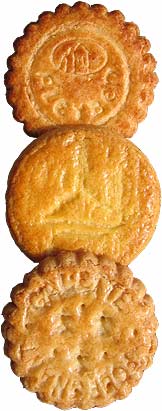
As we have previously reviewed the Galette Bretonne I'll be brief and note that happily all three test subjects were indeed different. The Tanguy were much as I had experienced before with a sweet egg glaze over a crisp biscuit whose pure butter combines with its sugar to give an almost butterscotch flavour. Indeed the Pleyben the thinnest of the three put me in mind rattling around the bottom of a pack of Butterkist Toffee Popcorn. The French call this sort of stuff 'croustillant' which means crunchy or crusty depending what its finding itself applied to. The third member of the trio made by Mere Poulard (translation: Mother small-Chicken (possibly a Bantam)). Although being glazed by eggs that are apparently 'extra-fresh', being embossed with a little picture of Le Mont St Michel and being packed in a lovely box, these were perhaps my least favourite. They just seemed to lack rustic charm of the other two. However, that said, they still followed same basic recipe of butter, sugar, flour, eggs, a little raising and maybe a drop or two of vanilla essence. With ingredients like that your biscuits are going to be tasty.
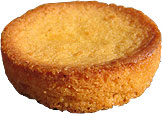
So to the Palet Bretonne and the first thing of note and seeing how we were just talking about is that the ingredients are fairly much the same for the galettes. The Palets are however about half an inch thick. The best way of describing them is like a very well baked piece of Victoria sponge that has ceased to spongy. It has about the same density and possibly flavour although once again the butter contributes greatly to this. As a dunker in warm tea the Palet is going to be quite interesting but in piping hot tea its romantic French construction is going to let it down.
All in all we had a very successful tea tour in France, and in our next news letter I'll be going in to depth on the formidable and highly impressive Kouign Amann cake. Your feedback 2 messages |